




















What is a Cable Tray?
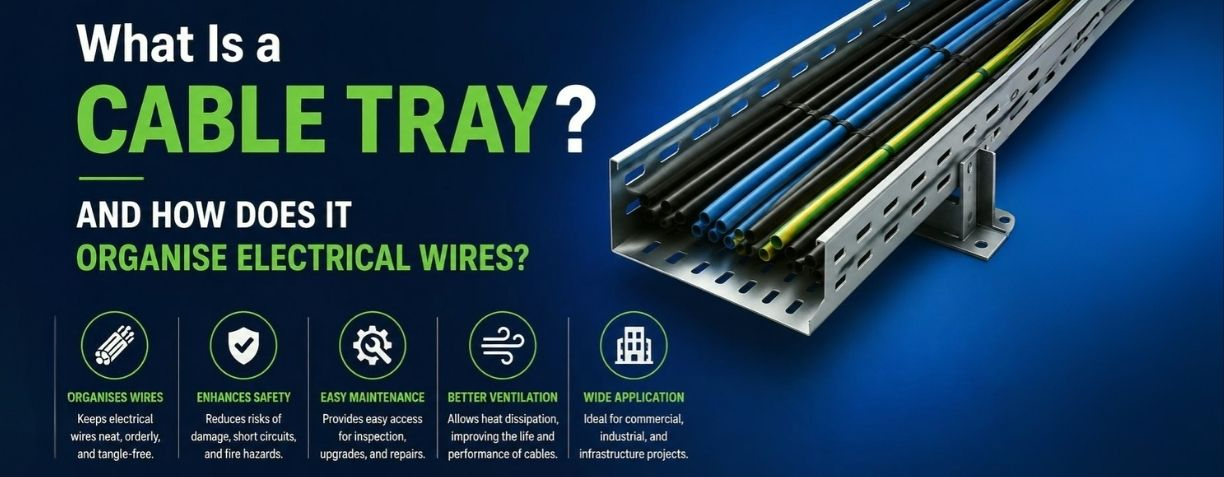
A cable tray is a support system that holds and routes insulated cables and wires to support efficient power distribution. It functions as an open framework, made of metal or other durable materials, to carry cables safely across different sections of a building or facility. Unlike closed conduits (pipe or tube), cables are easily accessible for modifications and maintenance. They are commonly used in commercial or industrial setups where multiple cables need to be managed efficiently.
Key Components of a Cable Tray
A cable tray is made up of multiple elements that work together for proper routing and stable management of cables.
- Tray Sections: These are the main lengths of the tray where cables are laid and supported.
- Fittings: Bends, tees, elbows, risers and cross sections, used to change directions or split routes.
- Supports: Wall brackets, hangers, etc., that secure the cable tray to walls, ceilings, or floors.
- Additional Accessories: Covers, clamps, dividers, and end caps that help protect and organise cables within the tray.
- Connectors: Also known as splice plates, connectors join different tray sections and fittings to maintain continuity and structural strength throughout the system.
Types of Cable Trays
| Type | Description & Application |
|---|---|
| Ladder Type Cable Tray | Designed with side rails and rungs like a ladder, it offers an ideal structure for heavy-duty cables and allows good ventilation to reduce buildup. |
| Perforated Cable Tray | Features a solid base with a series of small holes that offer moderate ventilation and support. The are commonly used in commercial buildings with medium to heavy cables. |
| Wire Mesh Cable Tray | Also known as a basket cable tray, this type is made of wire mesh and is lightweight and flexible. It is suitable for data cables and quick modifications. |
| Solid Bottom Cable Tray | Provides a completely solid base, free of perforations or holes. It offers maximum protection against dust, moisture, impact of electromagnetic interference, and other external factors. |
| Channel Cable Tray | A narrow tray designed for small cable runs. Its compact size makes it ideal for limited space and low cable quantity. Hence, it is used for small-scale applications. |
How Does a Cable Tray Organise Electrical Wires?
Cable trays organise electrical wiring through a structured and accessible pathway. Instead of running wires randomly or enclosing them completely, this system offers order through a:
- Defined Route: Cables are laid along a planned route, preventing clutter and keeping the wiring aligned across different spaces.
- Separation of Cable Types: Power, control, data, optical fibre, and mineral-insulated cables are arranged separately in a cable tray. This increases space efficiency while reducing interference.
- Support and Load Distribution: The cables are spread out evenly within the tray. Hence, the chances of sagging, tangling, or stress on certain connections are reduced, even over long distances.
- Ease of Identification and Access: The open layout makes it easier to trace individual cables, inspect them, or modify them without disrupting the entire system.
- Flexibility for Expansion: Additional cables can be added or rerouted as required without making major changes to the structure. This makes cable trays adaptable to future needs.
- Clear Maintenance Zones: When required, the cable tray setup leaves enough space for technicians to work around the cables without disturbing the entire route.
- Structural Compatibility: A cable tray guides cables through turns, elevations, branch points, and other curvatures easily, making it compatible with any type of structure.
Cable Tray vs Raceway: Key Differences
Both cable trays and raceways are used to route electrical wiring, but they differ in how cables are supported and protected. Here’s a side-by-side comparison:
| Aspect | Cable Tray | Raceway |
|---|---|---|
| Structure | Open structure with a resting platform for light to heavy cables | Fully enclosed changing housing the cables |
| Cable Accessibility | Easy to inspect, modify, or add cables | Limited access once the cables are enclosed |
| Ventilation | Allows airflow to reduce heat buildup | Minimal ventilation due to the enclosed design |
| Protection Level | Provides basic protection with easy access | Offers higher protection from dust, moisture, and damage |
| Installation | Faster and more flexible for large layouts | More structured and time-sensitive installation |
| Expansion Flexibility | Easy to expand or reroute cables | Modifications require opening the enclosure |
| Capacity | Medium to heavy weight of cables supported for long spans | Lightweight wires used in offices and residential areas |
| Cost | Cost-effective for large-scale installations | May be costlier due to enclosed design and labour |
| Appearance | More focused on functionality with an open-frame and large size | Neater look with a concealed finish |
| Materials Used | Typically made of steel, aluminium, or Fiber-Reinforced Plastic (FRP) | Made of steel, PVC, aluminium, and iron |
| Applicability | Ideal for industrial, commercial, and infrastructural setups | Suitable for residential, office, and indoor spaces |
Importance of Cable Trays in Modern Infrastructure
As electrical systems continue expanding across buildings and large-scale projects, cable trays are critical owing to the following benefits:
- Supports Scalability
Cable trays make way for system expansion without having to redesign the entire wiring layout. This is critical for growing facilities.
- Connects High-Density Electrical Networks
Organised routing is possible for spaces with extensive wiring, such as data centres, commercial complexes, and industrial plants.
- Improves Project Efficiency
As the installation time is reduced and modifications are easy, cable trays are practical for projects that run on a schedule.
- Maintains System Reliability
Well-managed cable layouts reduce stress on wiring systems, which supports consistent performance in long-term operations.
- Fits Diverse Environments
All kinds of infrastructural environments can accommodate cable trays based on distinct structural and operational requirements.
Applications of Cable Trays
Cable trays are versatile and adapt to different environments. They are typically used in:
- Commercial buildings such as offices, malls, IT parks and large-scale complexes to support extensive network of power and data cables spanning floors and sections.
- Industrial facilities and manufacturing units where heavy-duty cables connect machinery, control systems, and power sources over long distances.
- Data centres where high volumes of network and fibre optic cables need to be maintained.
- Infrastructure projects such as airports, railways, and metro stations, that require reliable cable routing across large layouts and complexes.
- Power plants and utility setups where high-capacity electrical wiring is used, and continuous operations are important.
Tips for Choosing a Reliable Cable Tray Solution
Getting the right type of cable tray depends on how well it fits the specific requirements of your setups, in the present and in the future. Consider these tips for an informed choice:
- Assess Load Requirements: The cable tray should be able to support the total cable weight and density without bending or straining the structure over time.
- Factor in Installation Needs: Consider the complexity of your layout, mounting conditions, and the available space to choose a cable tray that fits perfectly.
- Prioritise Quality: Opt for a cable tray made of durable materials like galvanised steel and high-grade metals that can withstand environmental exposure and long-term usage.
- Check Compliance: Verify if the cable tray meets Bureau of Indian Standards (BIS) and International Electrotechnical Commission (IEC) standards to ensure safe operations.
- Consider Supplier Reputation: A trusted supplier with years of operation offering consistent quality and proper specifications reinforces quality.
- Evaluate Serviceability: Choose a cable tray that meets the criteria of easy access and maintenance over the long run.
Difference Between Cable Tray and Cable Trunking
Cable trays and cable trunking are two types of cable management systems that differ in how cables are housed and accessed.
A cable tray is an open or semi-open system. It is designed for larger cable volumes with features like easy inspection, ventilation and modification. It is suitable for industrial and commercial setups where flexibility and scaling are important.
Cable trunking, on the other hand, is a fully enclosed system that houses cables within a rectangular or square-shaped protective casing. It protects cables from dust, moisture, and other external damage factors. It is suitable for indoor spaces where appearance and safety are a priority.
Conclusion
Cable trays provide an organised and adaptable cable management setup for growing electrical systems. With a well-connected cable tray, layout efficiency and long-term usability are maintained. Compare types of cable trays, considering your current requirements and future plans, to create a practically defined wiring system.