





















Introduction
A lot has changed in how we consume electricity with smart homes and evolved industrial setups. What hasn’t changed is how electrical circuits form the base of protection in electrical systems. They prevent damage by cutting off power during overloads and short circuits. Although their core purpose remains the same, their capabilities and usage differ. This blog explores the difference between MCB and MCCB to clarify their roles as circuit breakers.
What is an MCB?
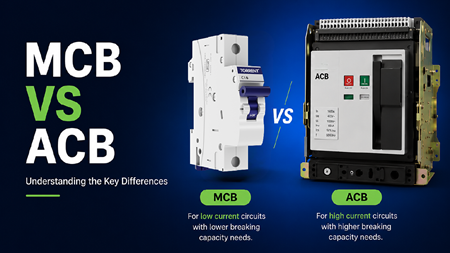
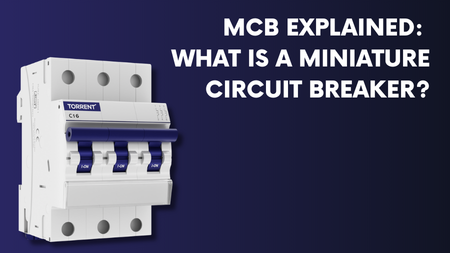
MCB, short for Miniature Circuit Breaker, is an electromechanical device that automatically switches off the electric circuit upon detection of abnormal conditions. For instance, it senses the overcurrent caused by a short circuit, and its movable contacts disconnect from the fixed contacts. This leads to the circuit opening and separating from the main supply. Thus, it protects the electrical system from bearing the impact. MCBs are typically used in low-voltage electrical installations, such as residential and commercial sub-circuits and individual lines.
What is an MCCB?
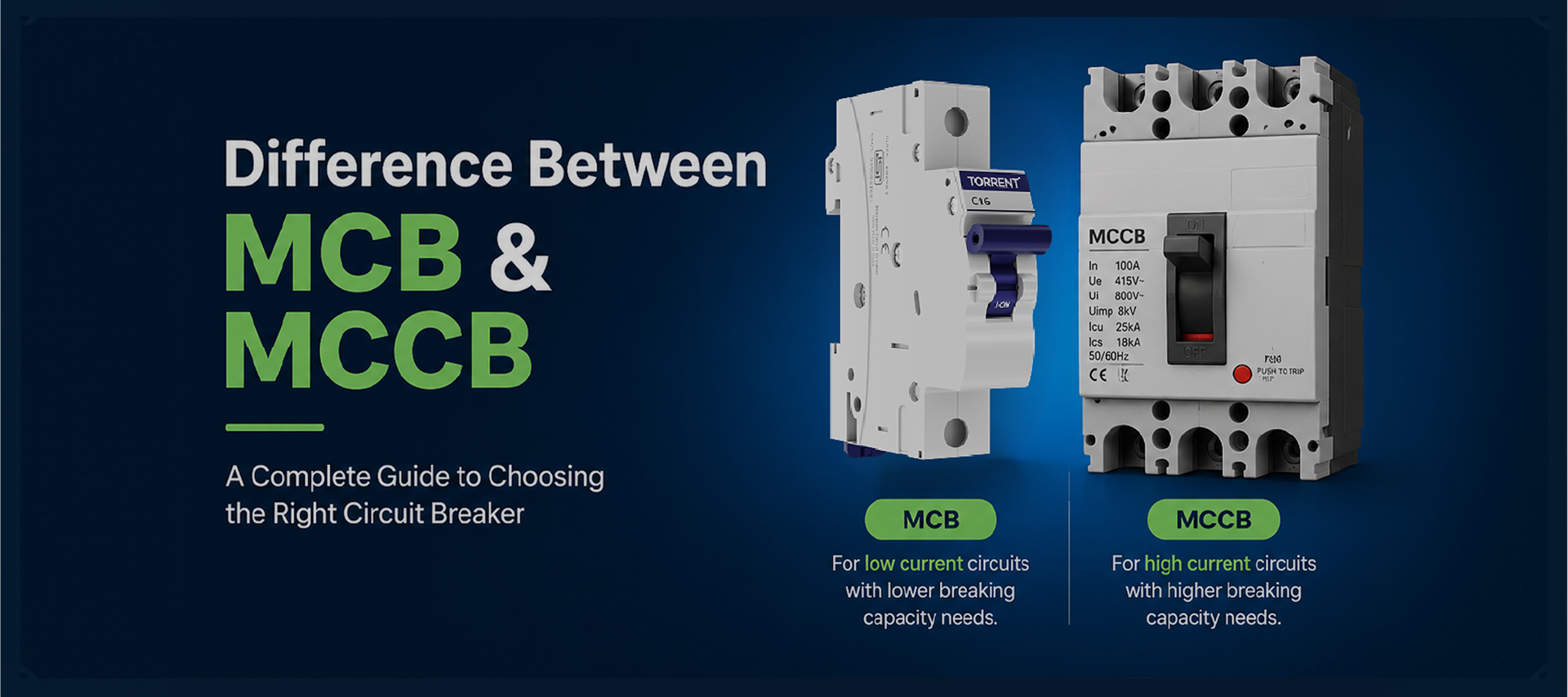
MCCB stands for Moulded Case Circuit Breaker. It is an advanced version of an MCB used for protection in higher-current applications. While it works on a similar principle of interrupting the circuit during overloads or short circuits, greater control is restored through adjustable trip settings. They work automatically but can also be controlled manually through a switch or remotely. It interrupts the current flow during abnormality by using a combination of thermal and magnetic mechanisms. MCCBs contain a bimetallic strip for heat-based overload protection and a magnetic coil for instant short-circuit protection.
MCB vs MCCB: Key Differences at a Glance
A detailed breakdown of the MCB vs MCCB distinction for a clearer view:
| Point of Difference | MCB | MCCB |
|---|---|---|
| Current Rating | Usually up to 125A | Typically ranges from 16A to 1600A or higher |
| Interrupting Capacity | Lower, up to 10 kA | Higher, up to 100kA |
| Application Area | Residential use, especially in branch circuits like lights and power points. Small commercial and industrial applications with low-capacity requirements. | Industrial, large commercial installations, and as a main breaker in residential settings. |
| Flexibility | Fixed, non-adjustable trip setting | Adjustable trip settings with remote operation for opening and closing |
| Physical Construction | Compact, space-efficient, and lightweight | Relatively larger with a moulded insulated casing |
| Turn-Around Time | Faster turn-around (milliseconds) | Comparatively slower turn-around (milliseconds to seconds) |
| Cost | Less expensive due to simple design and low capacity | More expensive owing to the higher capacity |
| Maintenance | Minimal with limited periodic inspection. Usually replaced and not repaired | A more structured and regular maintenance schedule involving checks, cleaning, and testing of trip units. |
| Poles | Available in single, two, three, and four pole options | Typically, available in three and four pole options |
Conclusion
The MCCB vs MCB comparison primarily comes down to different applicability and capacity to interrupt current flow in a circuit. Aligning the right breaker with the right load conditions based on performance and safety is key.
The difference influences how effectively electrical networks handle load variations and faulty conditions. Also, factoring in the cost and adjustable functions helps with better planning. A well-thought-out approach to selection based on the MCB vs MCCB features offers long-term resilience.